Skateparks
Designing Spaces for Skateboarding between Subculture and Sportisation
Abstract
The construction of public skateparks is booming. But how can these building projects, conceptualized to serve their purpose for decades, be designed in a long-term, sustainable manner for dynamic movement practices such as skateboarding? The underlying conflict: These publicly funded skateparks need to serve a maximum number of potential users, but at the same time offer the core target demographic a viable alternative to their free exploration of urban spaces.
The following discourse is an excerpt from a dissertation published by Veith Kilberth that provides actionable concepts for the kinds of sociocultural aspects ideally implemented into skatepark design.
These highly condensed talking points can be perused in their entirety in the referenced sections of Kilberth’s book.
Demand for Skateparks
1. Spatial Conflict
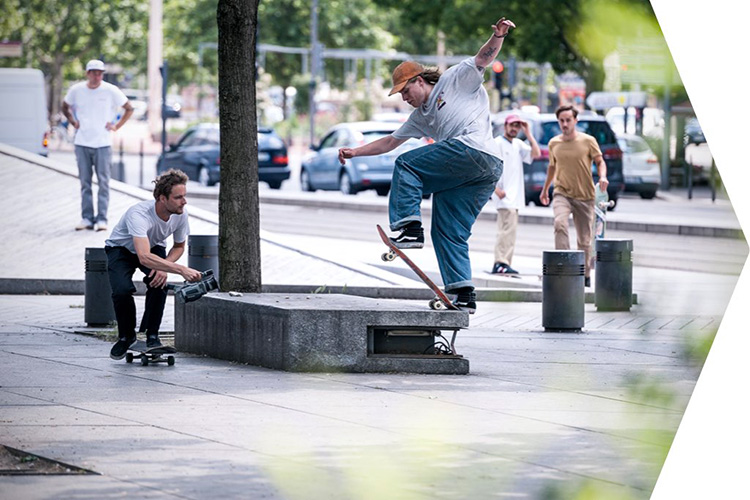
Street Skateboarding
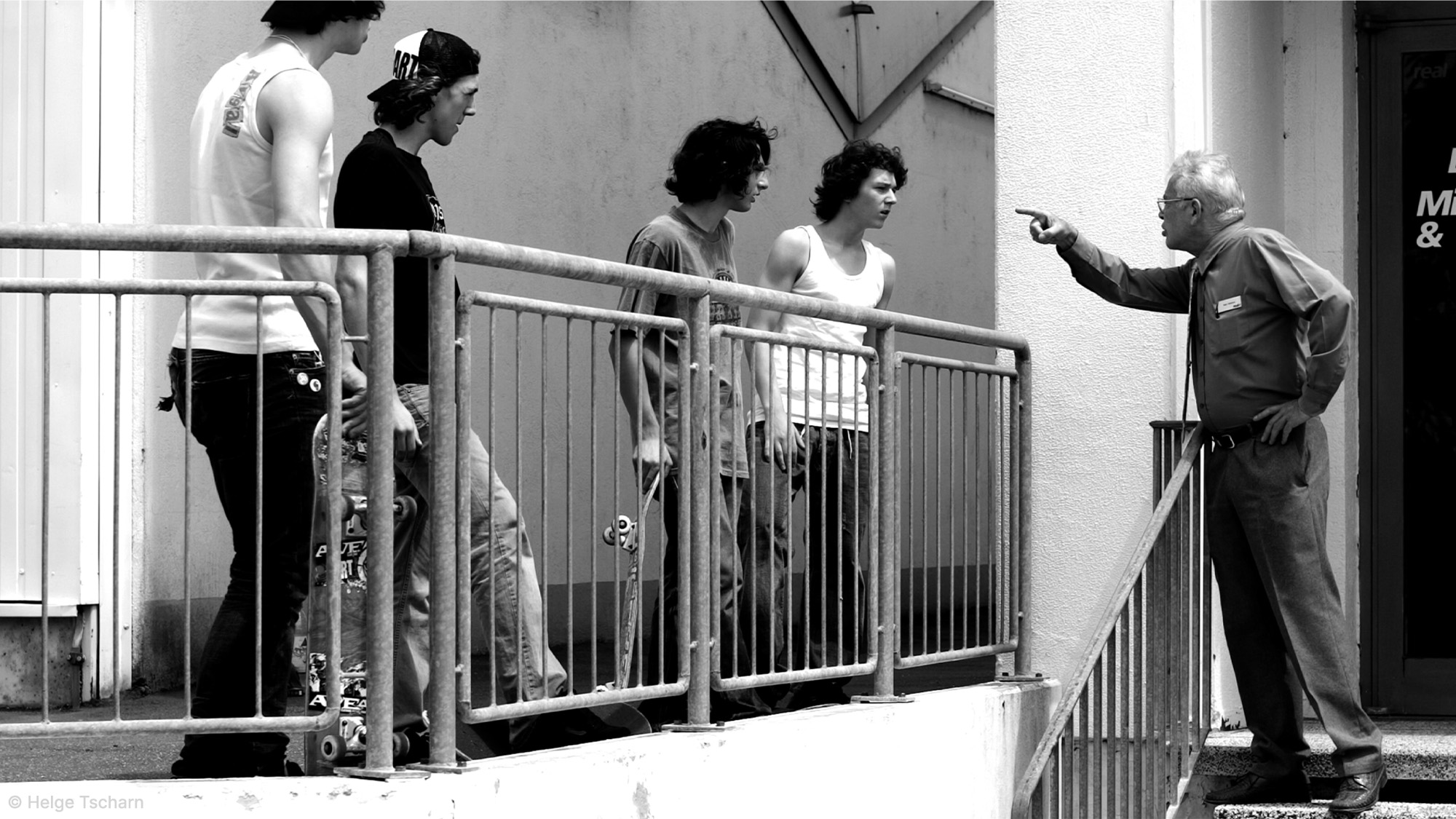
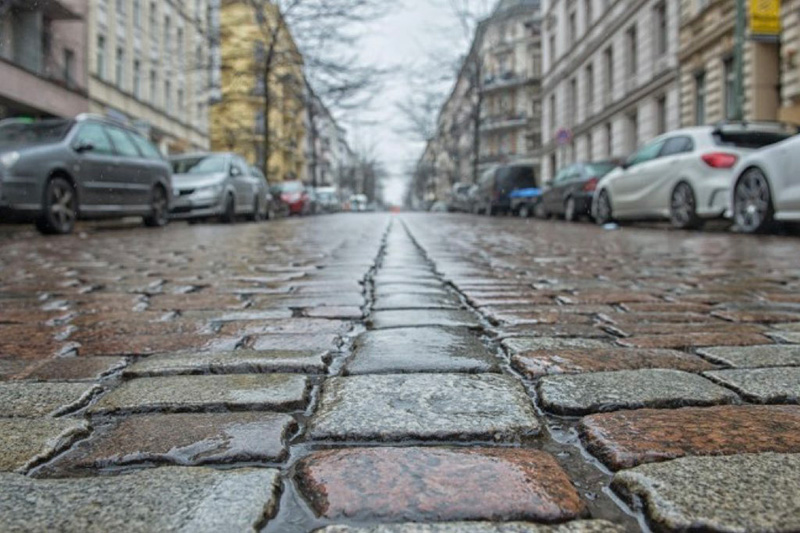
Appropriation of public space in early 1990s by skateboarders & inline skaters.
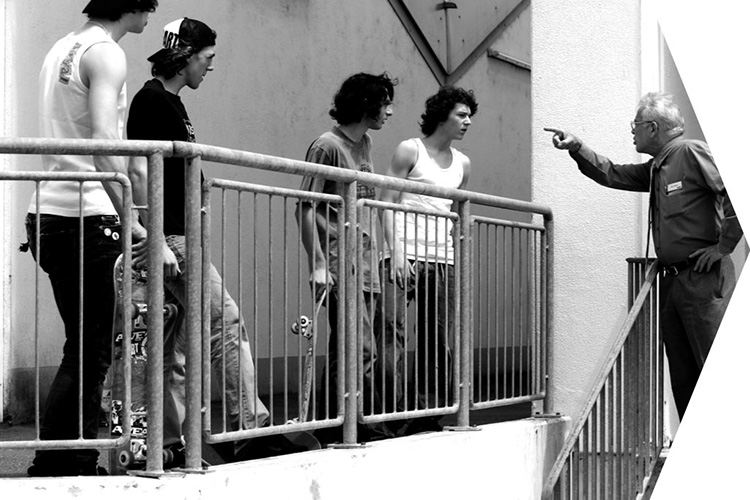
Spatial conflict
Noise, endangerment, damage and trespassing.
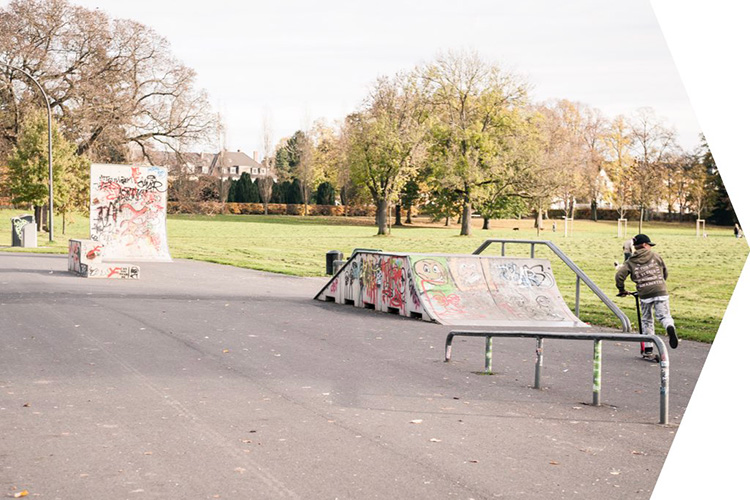
Catalogue skateparks
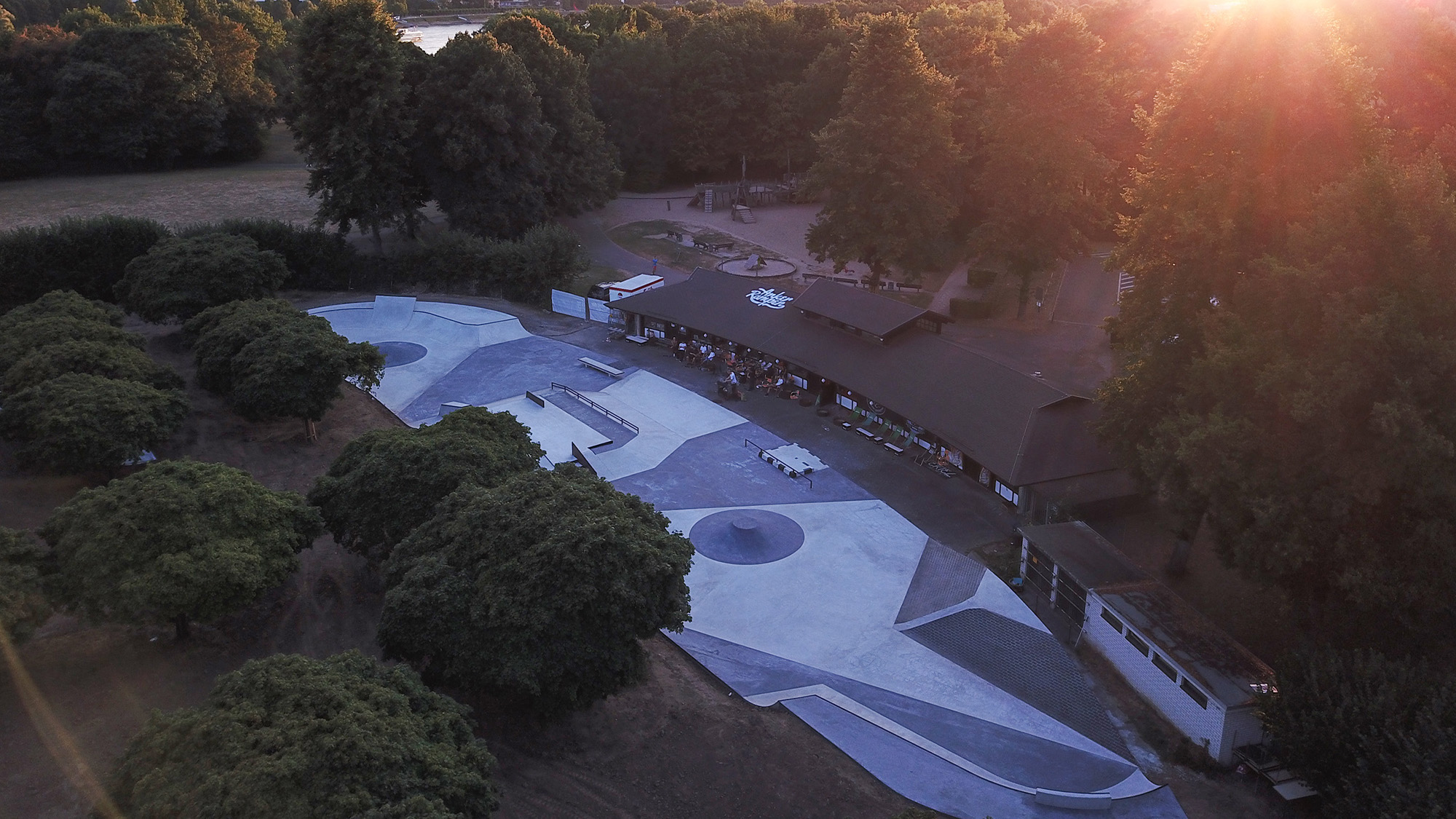
Municipal policy solution creates purpose-built spaces for skateboarding:
Around 1995-2005, planned without user participation, era of pre-fabricated standard-issue skateparks.
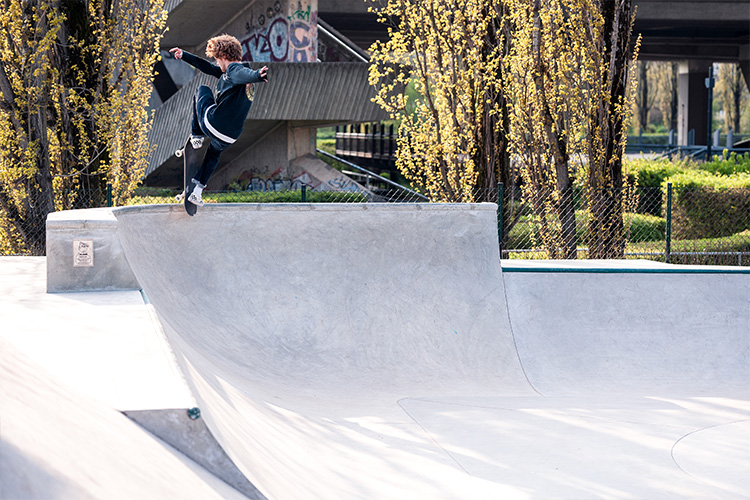
In-situ concrete
Skateparks shaped of in-situ concrete since approx. 2010, often planned involving end users. Customized, state-of-the-art skateparks.
2. Local Demand
The demand for skateparks is not only driven by spatial conflict, but also by lack of feasible locations in the area (e.g. street spots), as well as local needs and requirements (e.g. transition terrain such as bowls or mini ramps).
Rural regions
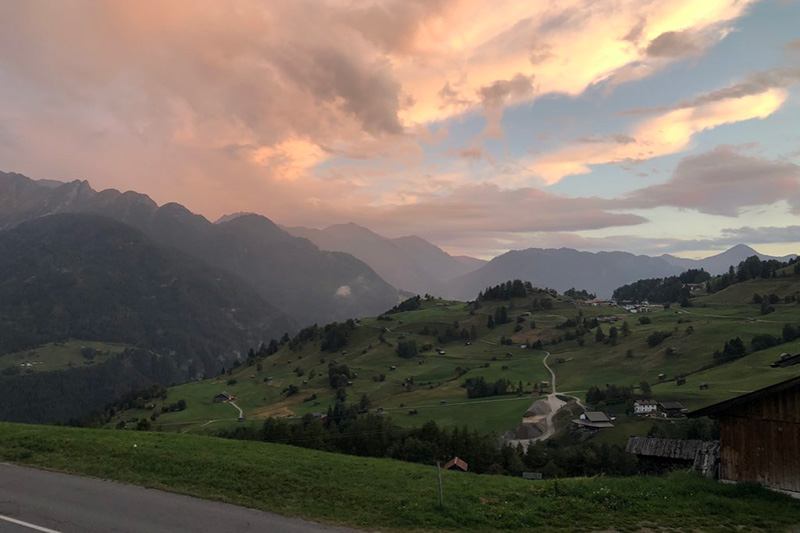
Need for transition terrain
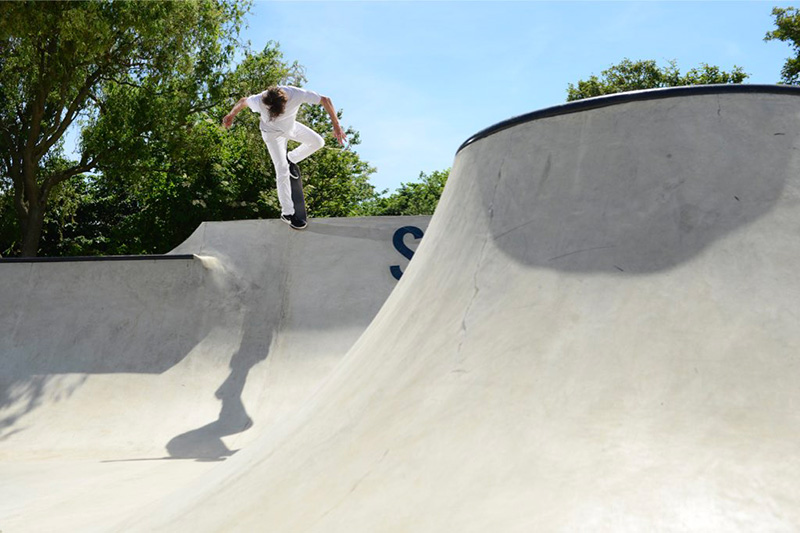
Lack of feasible urban spots
Social Aspects
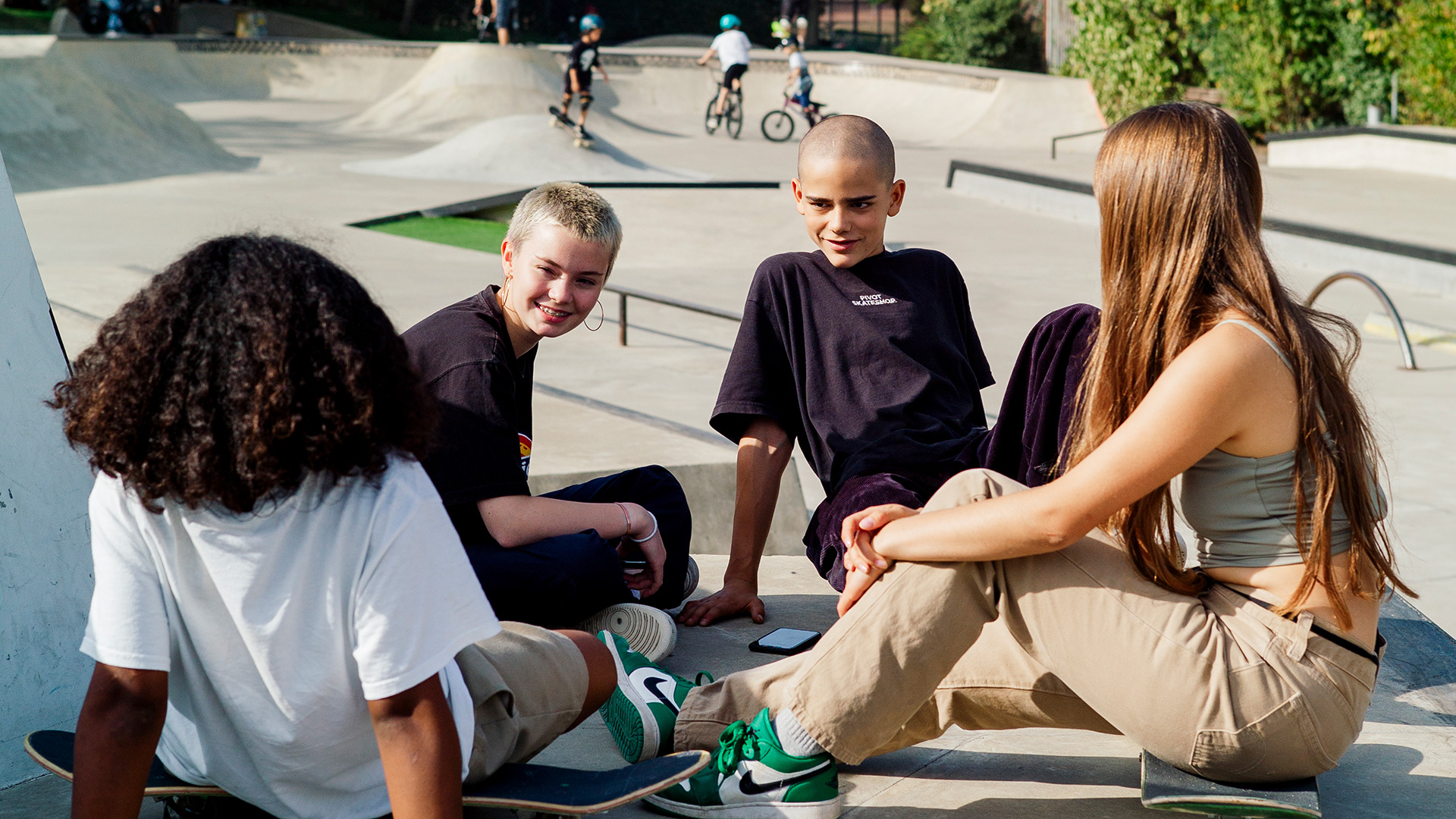
In order to align public skateparks with the common good, they should manifest – at least in principle – a social structure embedded in their design.
1
Largest possible user group
(Skate, BMX, Scooter, WCMX, etc.)
2
Inter- generationality
(From young to old users)
3
Inter- performativity
(For every skill level)
Social Benefits
Skateparks can offer social benefits on various levels:

Informal exercise

Safe spaces

Extracurricular sites of learning

Inter-generationality

Refugee support

Place of retreat for adolescents

Sports for the disabled

Scene meet-up spot
The Dilemma Behind Skateparks
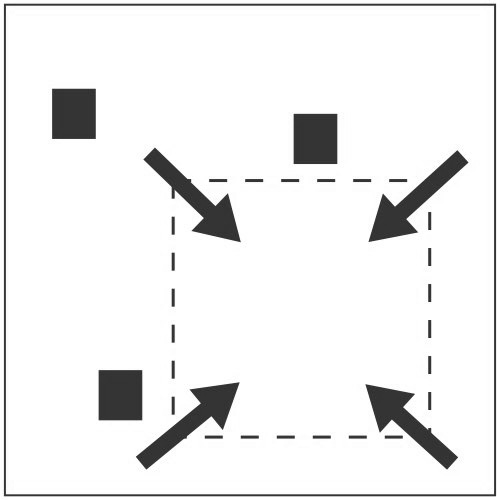
Alongside the proliferation of public skateparks, the criminalization of skateboarding in public space also increases.
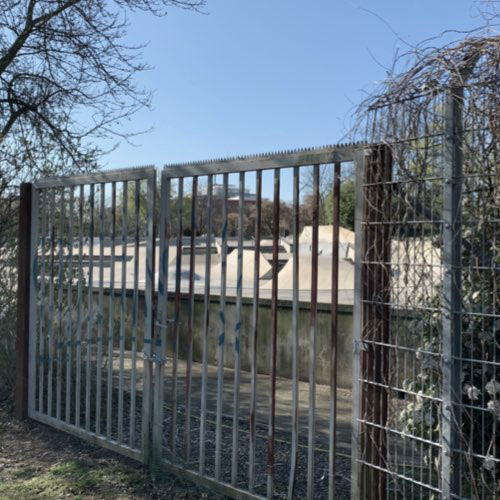
Found Spaces
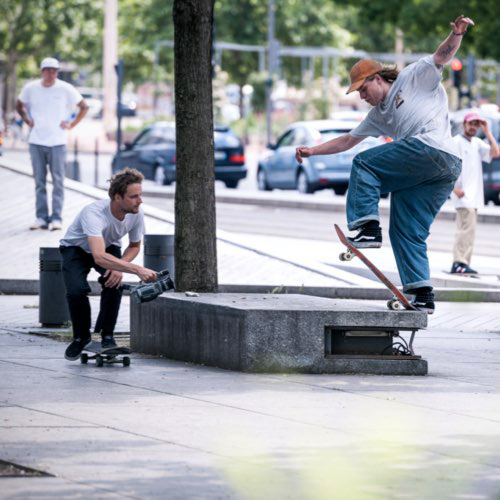
Shared Spot
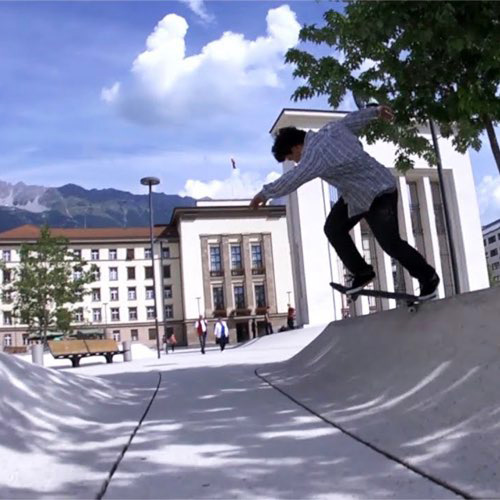
Public sports facility
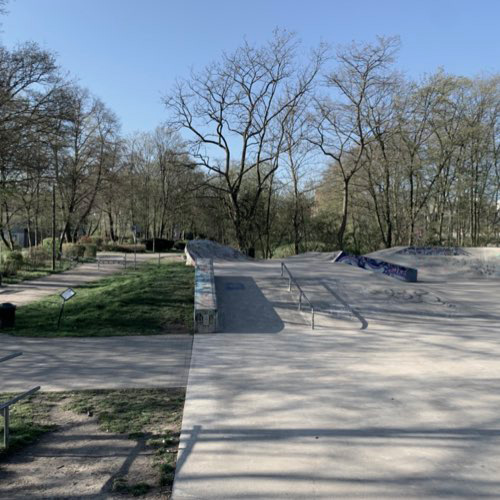
Private club facility
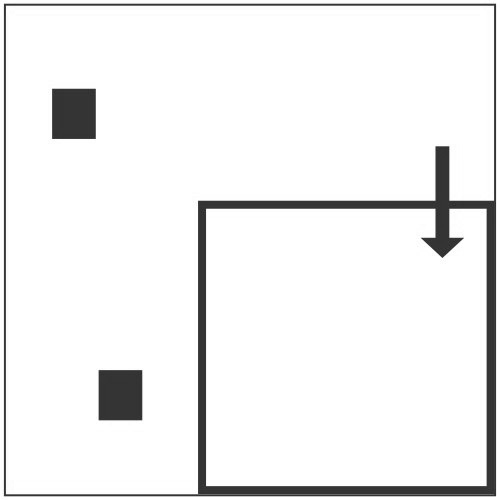
→ Degree of domestication & potential for social regulation →
Public skateparks and their underlying domestication of movement practices can unlock the aforementioned social aspects. But these social benefits come at the expense of the free exploration of the city through skateboarding. Solutions are provided by the skate space genesis and the positioning model.
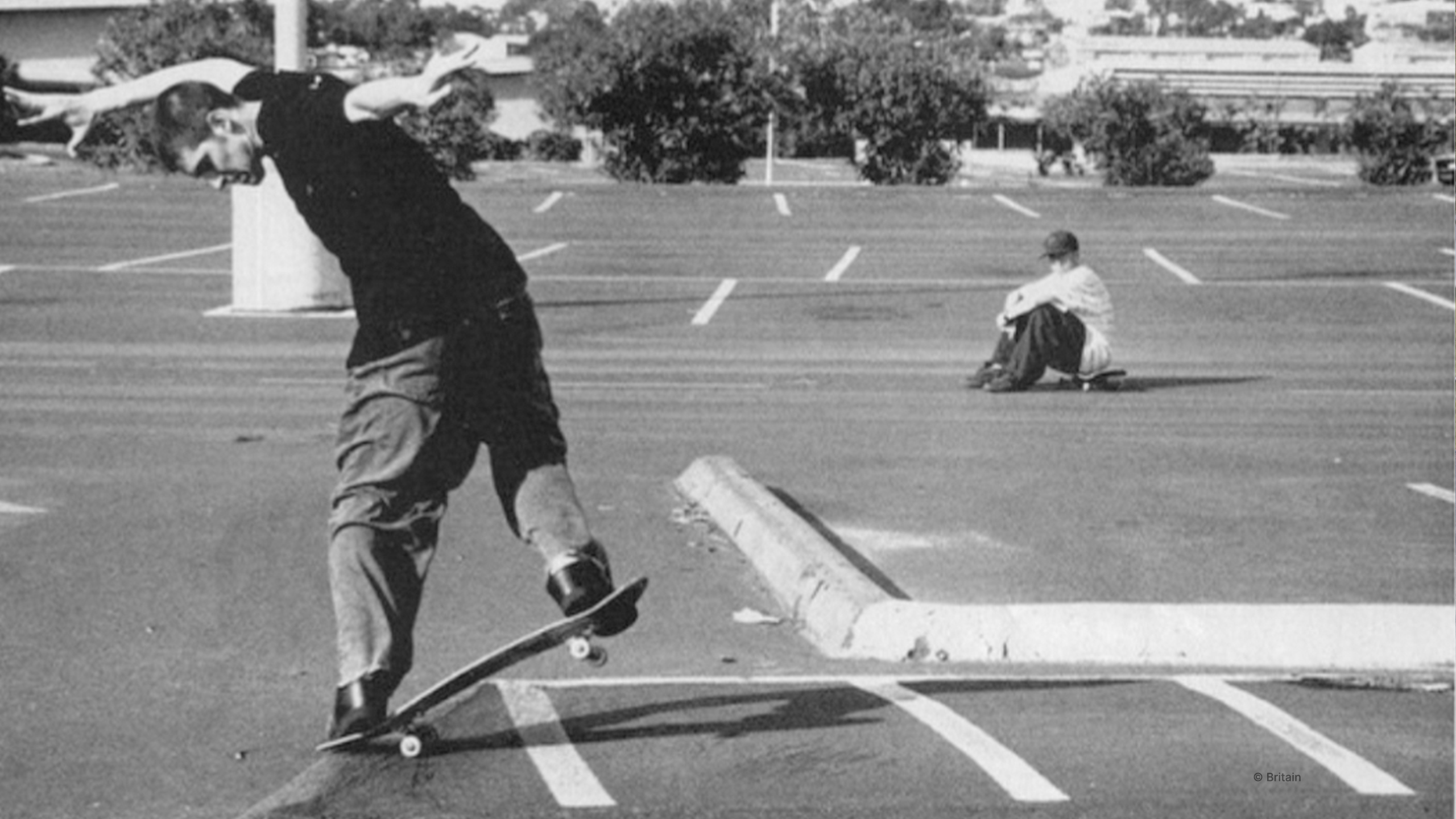
Identity-forming Aspects of Skateboarding
The underlying identity-forming aspects of skateboarding can be outlined via a historic reconstruction of preferred spaces for skateboarding. In the process, the two main terrain categories – transition and street – are analyzed on a micro, meso, and macro level.
Historic Terrain Reconstruction
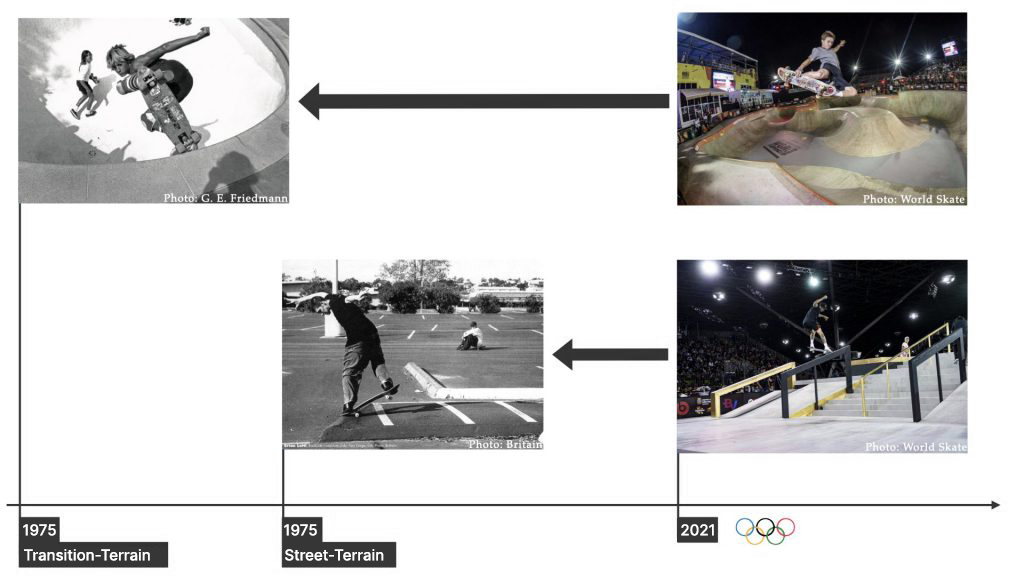
1. Micro-Perspective
2. Meso-Perspective
3. Maso-Perspective
1. Micro-Perspective
With a sociology derived from play, as grouped into game categories by Roger Caillois, skateboarding’s spatial structures and constellations can be analyzed on a micro level.
1.Sub Cultural Terrain
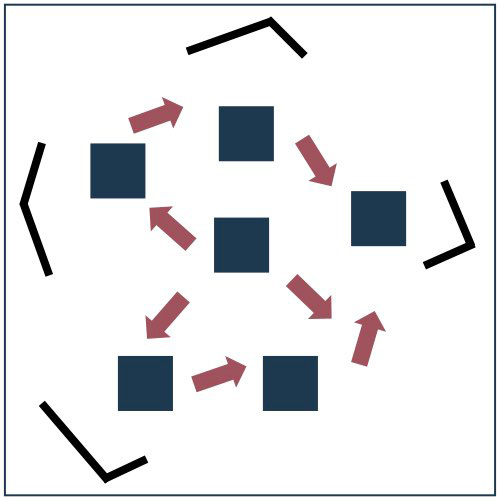
Play style: Ilinx (vertigo)
Modus: Paidia (wild, uninhibited play)
Structure: multi-directional
Disposition: creative / style-driven
e.g. Pool, Bowl, Olympic Park
2. Sportified Terrain
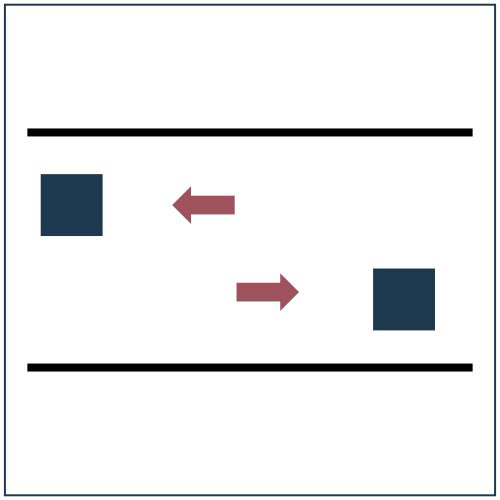
Play style: Agon (competition)
Modus: Ludus (disciplined, structured play)
Structure: linear
Disposition: athletic / progressive
e.g. Halfpipe, Miniramp, Olympic Street
The spatial-structural factors behind a sportified mode of play:
1 – Standardized terrain and elements (shape of skatepark components)
2 – Unhindered, linear approaches towards elements, favoring a focus on single tricks (terrain structure)
2. Meso and 3. Macro Perspective
Using a sociology based on play, Roger Caillois’ categories of play can be used to analyze structures and constellations at the micro level in skate spaces.
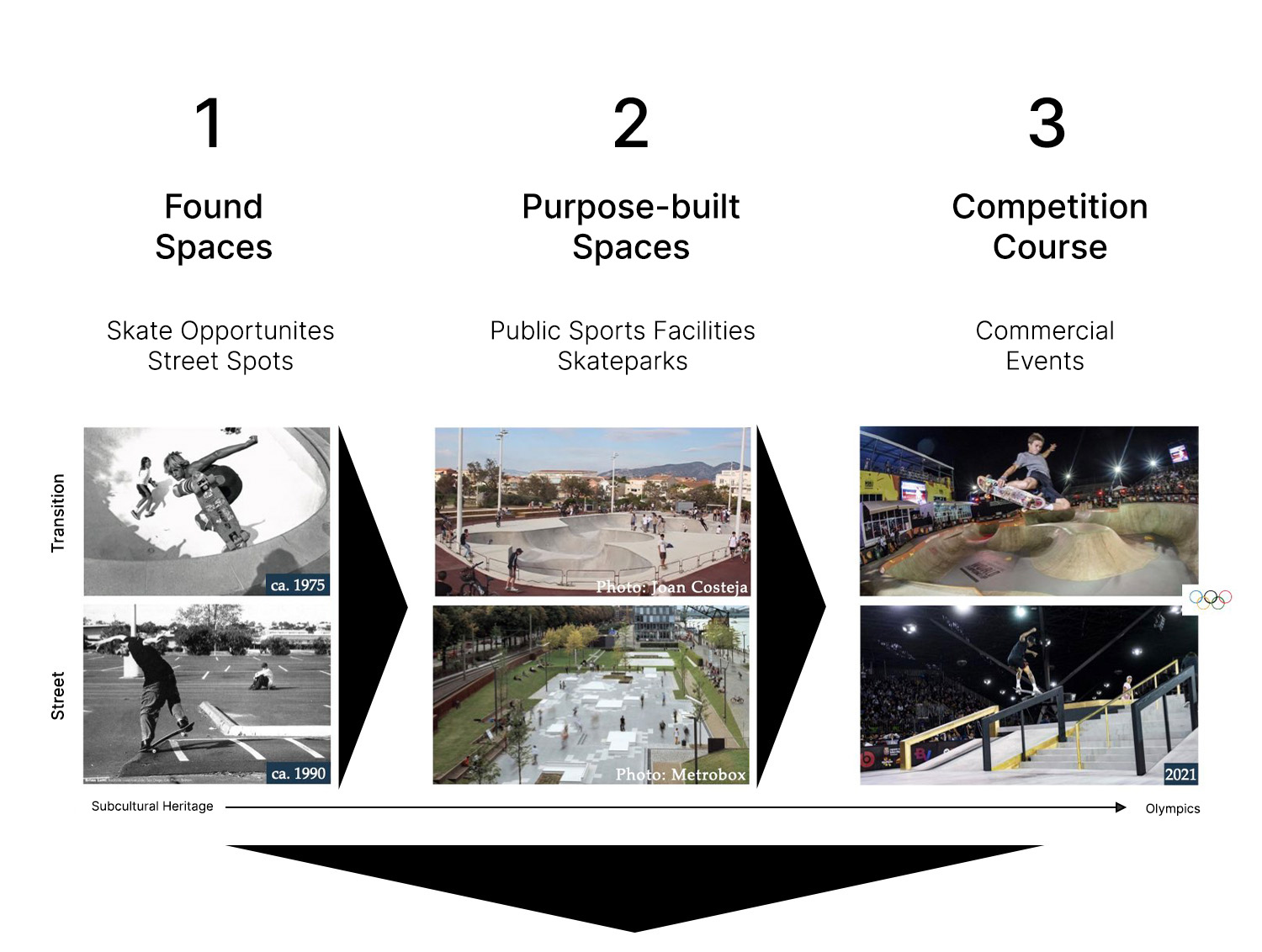
Dynamic Terrain Configuration Pattern
Prevailing terrain evolution patterns:
- Found spaces
- Purpose-built terrain
- Competition courses
Self-directed play of bodies in found spaces reconceptualized as externally determined competition formats.
Dynamic process of skateboard terrain configuration, in which the subcultural expression continually reinvents itself.
Identity Traits of Skateboarding
The historical reconstruction of skateboard terrain outlines the following ten identity-forming aspects of skateboarding:
1
2
3
4
5
6
7
8
9
10
The higher the degree to which these characteristics are applied to spaces for skateboarding the deeper the end users will resonate with the space and the greater the chance that the design stand the test of time and remain relevant in the long run.
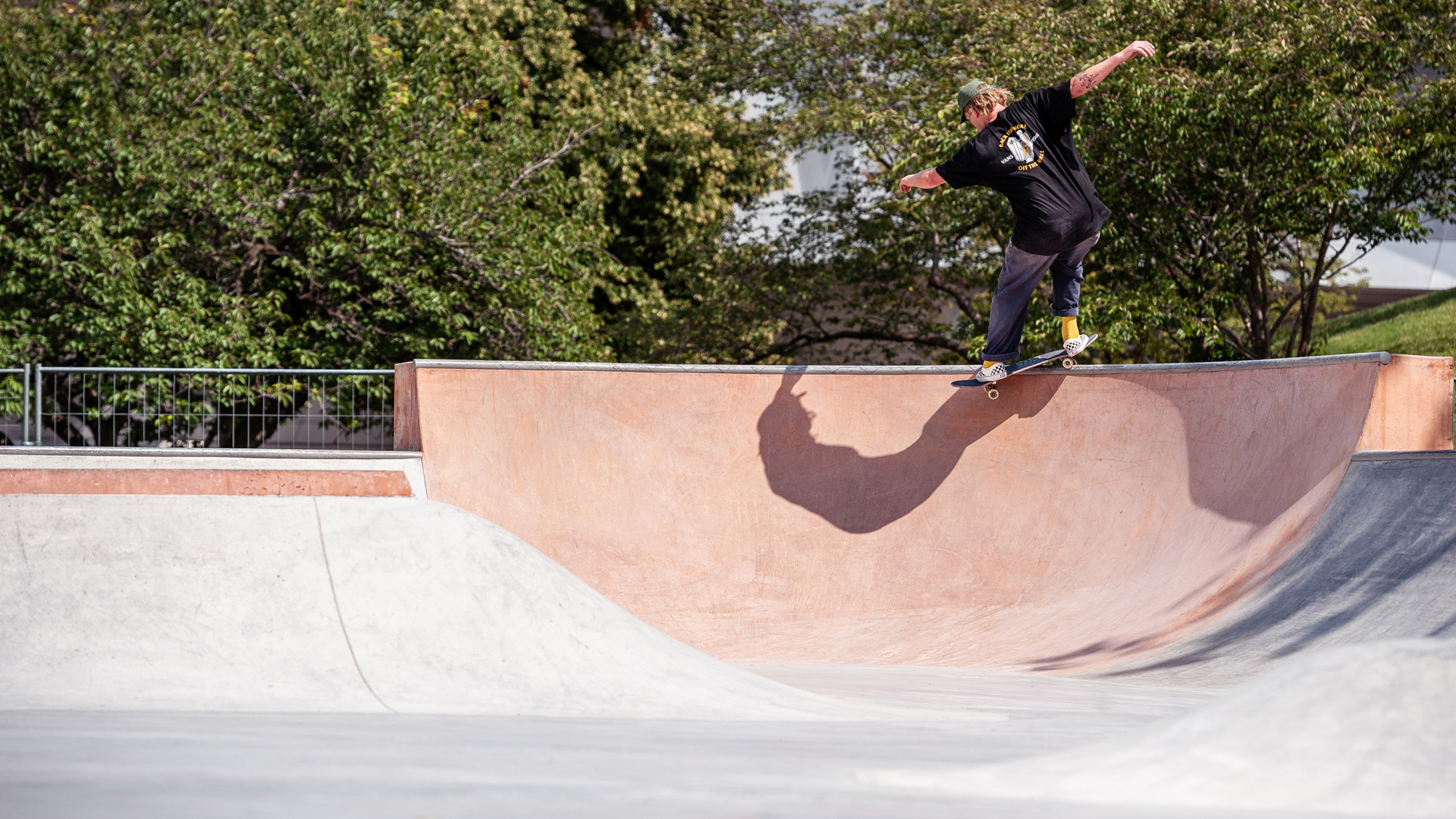
Concept of fundamental skatepark design aspects
From scientific insights to actionable design guidelines. In order to leverage the identity-forming aspects of skateboarding into spatial concepts, they need to be aligned with planning processes on a municipal and skatepark-specific level:
Municipal and skatepark-specific planning processes:
The groups of individuals and organizations involved in municipal skatepark planning, as well as the main planning areas, can be visualized as follows:
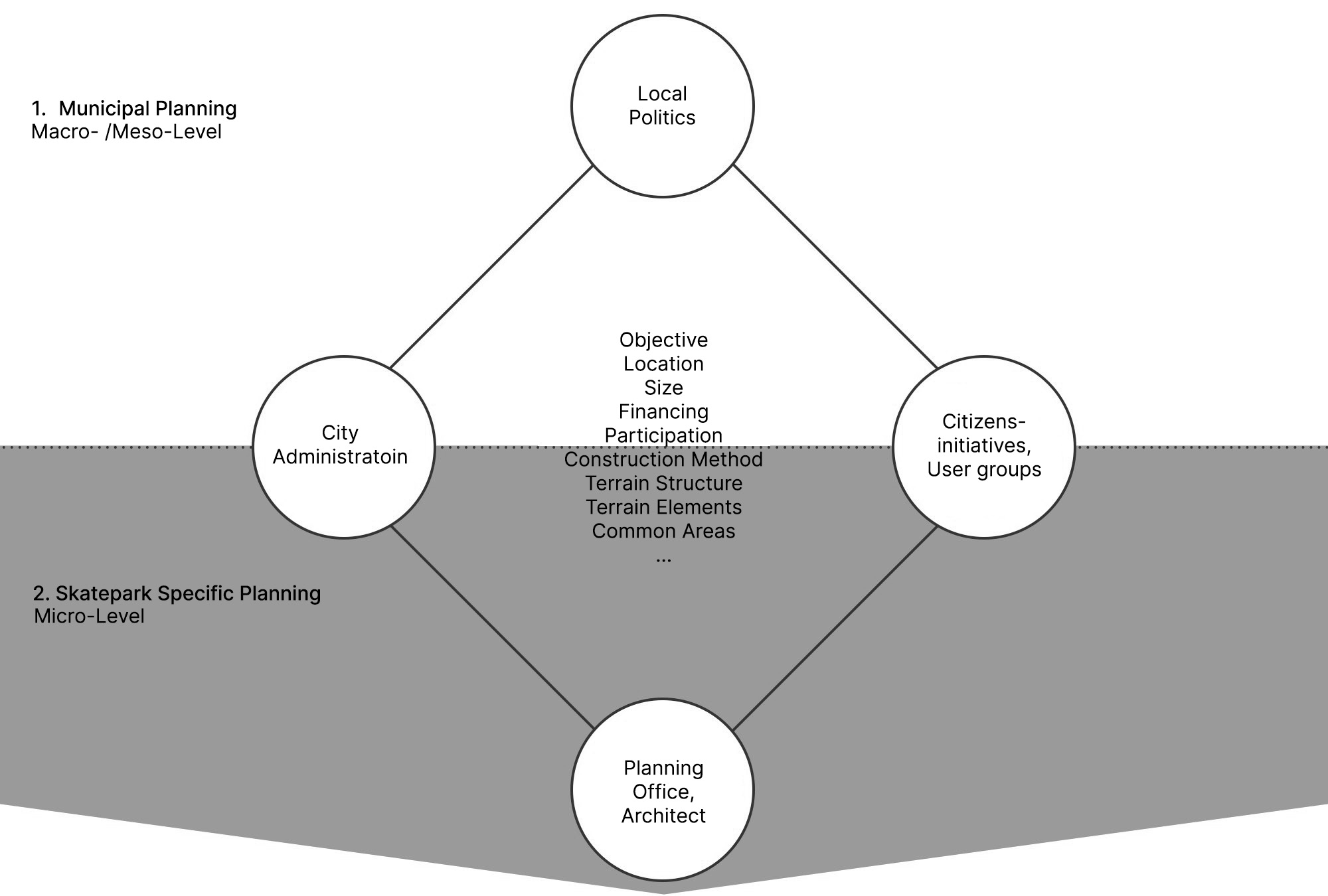
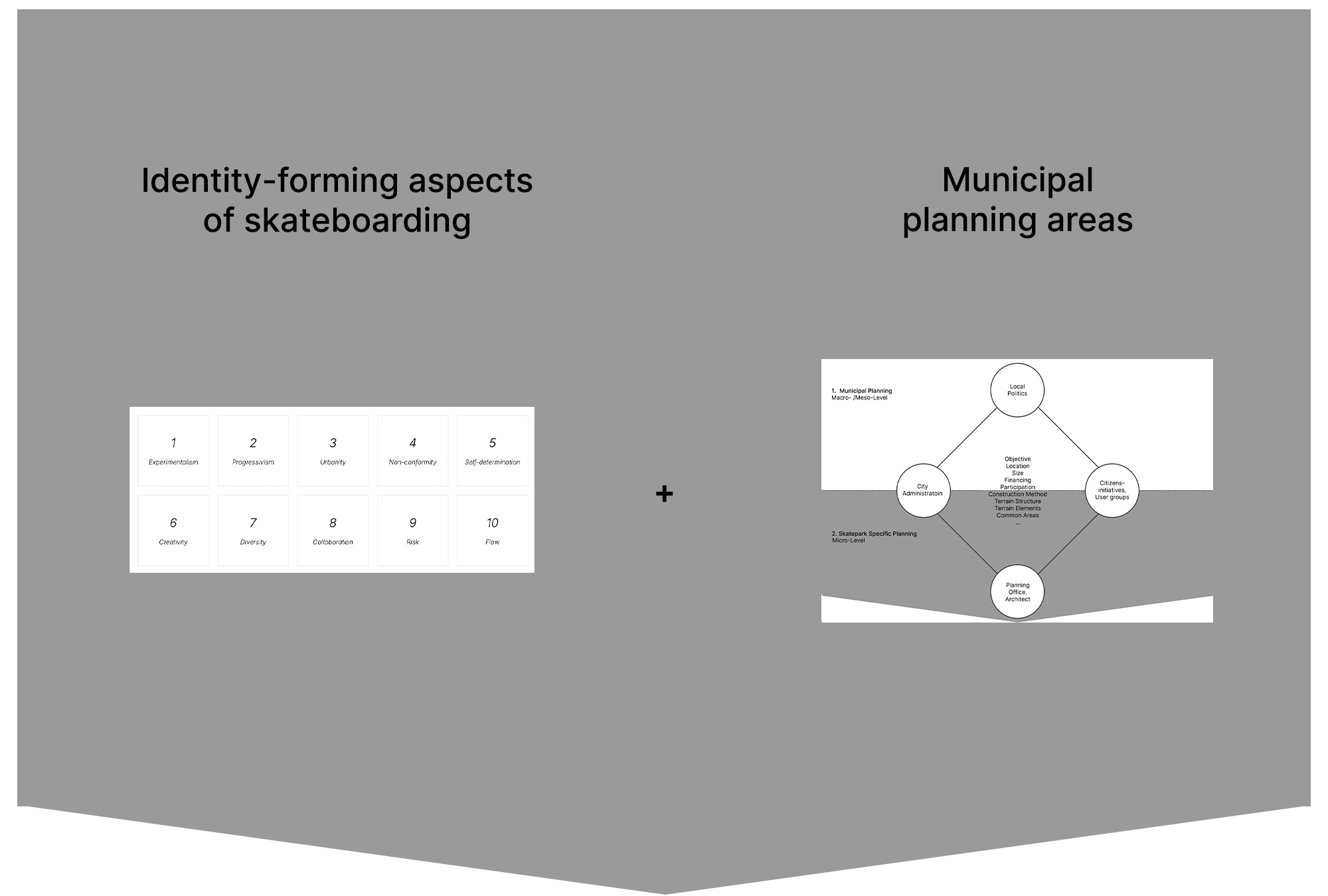
In order to define fundamental design guidelines for skateparks, the identity-forming aspects of skateboarding are applied to the previously outlined sectors of municipal planning.
Matrix
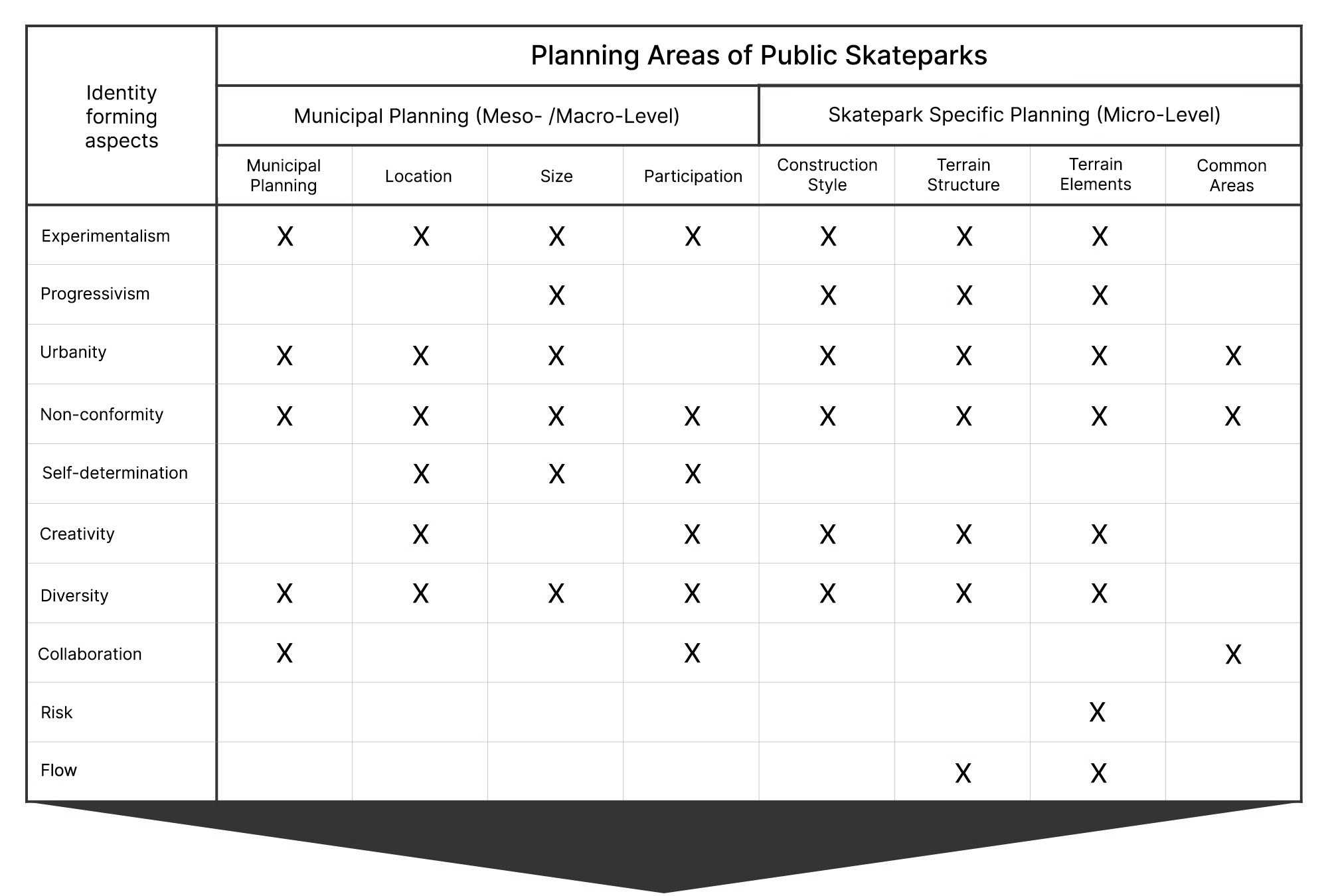
23 Fundamental Design Principles
Municipal Planning Level (Meso / Macro Level)
Municipal Planning
1. Local Needs and Requirements
The offering of skateboard spaces is focused on local needs. In turn, every project has to be aligned with the overall offering in the municipality and designed as diversified as possible.
2. Unconventional Skateboard Space Concepts
Experimental and non-conformist concepts of skateboard spaces should be considered at the municipal planning level.
Location
3. Central Location
Position skateparks in central locations at busy, well visible sites.
4. Maximum Operating Hours
When choosing the location, also factor in the maximum number of operating hours.
5. Urban Spaces
In addition, consider non-conformist and experimental urban spaces as skateboard locations.
Size
6. Smaller Skateparks
On the regional municipal level, rather plan several relatively small skateboard facilities instead of fewer, larger skateparks.
7. Limited Terrain Size
Make sure not to exceed the maximum size for skatepark terrain.
Participation
8. Local Participation
Always involve local end users in the planning of skatepark projects and respect their needs and requirements as much as possible.
9. Informal Communication Channels
Create informal, unconventional channels of communication to reach end users and involve them in a participatory planning group.
Skatepark-Specific Planning Level (Micro)
Construction Style
10. In-situ concrete method
Plan and build state-of-the-art skateparks with the in-situ concrete method.
11. Quality over Quantity
In case of budget limitations, prioritize smaller and higher quality skateparks instead of filling larger spaces with relatively low-quality construction methods and materials.
12. High-Quality Riding Surface
The ground of a skatepark facility should be crafted from the smoothest, high-quality surface available.
Terrain Structure
13. Overall Terrain
Accommodate for different skill levels by structuring areas with different speeds, integrated into the overall terrain structure.
14. Incremental Structure
The height and difficulty level within the skatepark terrain should be designed to increase incrementally.
15. Multi-line Structure
Structure terrains with as many multi-directional pathways as possible.
16. Wider Base Area
Avoid a narrow, elongated base area and prefer geometrically proportional, wider spaces.
Terrain Elements
17. Unique Character
Every skatepark should be designed with a unique character and offer at least one defining characteristic feature.
18. Low Overall Height
Street terrains should be planned with a relatively low overall height of elements/obstacles, but also offer more challenging elements.
19. Creativity and Variety
Skateparks are designed according to skateboarding’s socio-cultural aesthetic and should provide a broad spectrum of different elements/obstacles.
20. Urban Flair
Keep demarcations along the borders of the skatepark space as well as functional safety installations at a minimum in order to create an authentic, urban flair. Use alternative measures to meet safety guidelines.
21. Prioritize Basic Features
Start by incorporating a sufficient number of basic skatepark features, then integrate more specialized features.
Common Areas
22. Multiple Common Areas
Plan various common areas in varying proximity to the skate terrain: Always provide common areas in a central location directly at the skate area, but also in peripheral distance with a close view of the action.
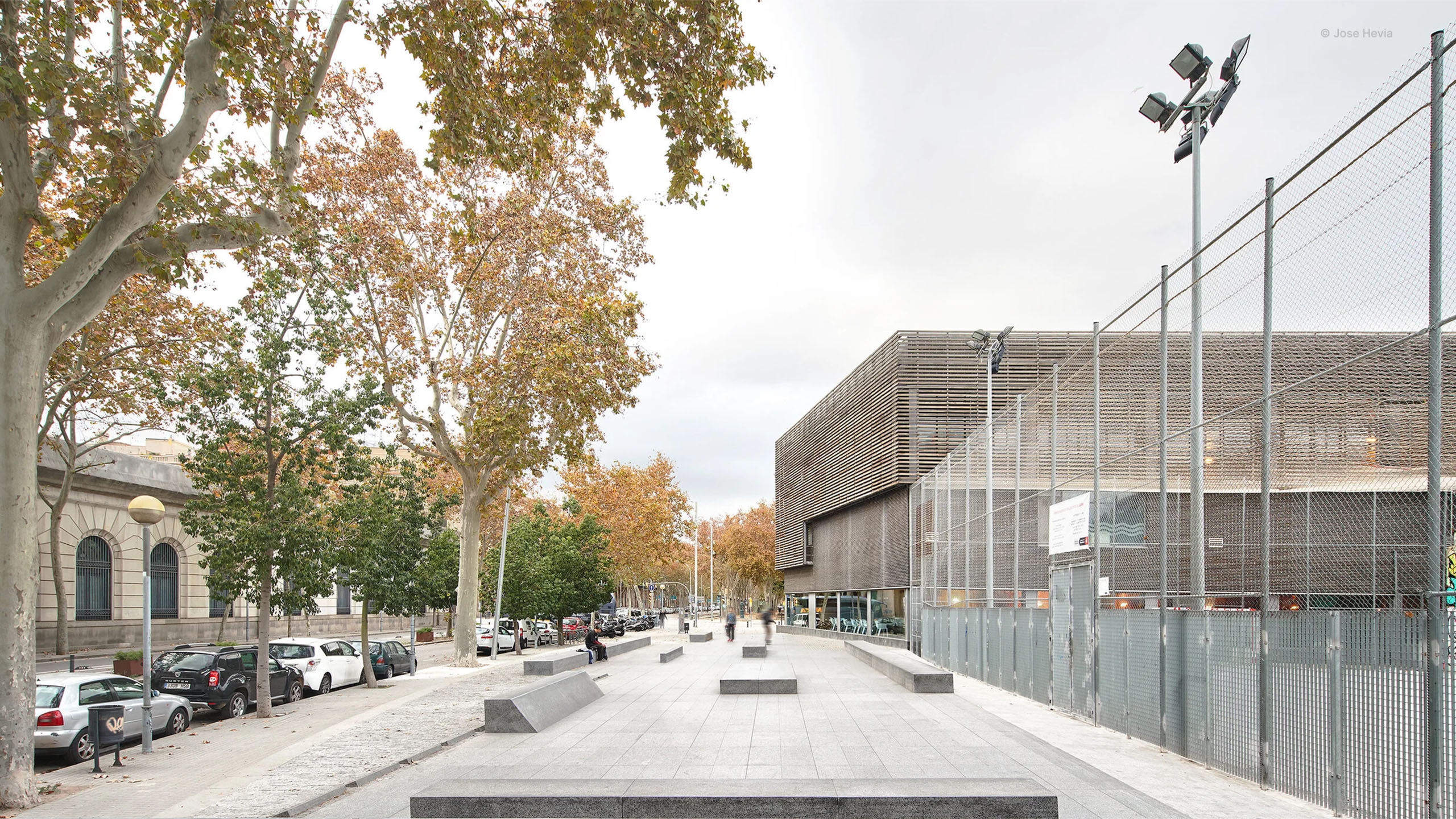
23. Urban Furniture
Common areas in skateparks should be equipped with authentic, urban furniture found in public spaces in order to avoid the aesthetic of bleachers and ‘sports facilities’.
The Future of Skateparks
The Skateboard Space Genesis
Looking ahead, the proliferation of skateparks could lead, in consecutive phases, to a number of increasingly complex spatial concepts for skateboarding in municipalities:
I. Single Case-Skatepark
State-of-the-art skatepark planned with a high level of end user participation realized as single case project at traditionally zoned sites according to municipality’s overall urban planning directives.
II. Communal Skatepark-Offering
Several skatepark projects orchestrated as part of an overall, communal skatepark offering. This second stage of the skateboard space genesis is constituted of separate skatepark projects built at designated sites but integrated into the context of a community-wide offering.
III. Diversified Communal Skatepark Space Concept
In the next step of the evolution, the traditional offering of skateparks planned with end user participation and built at demarcated sites within the municipality is expanded by another dimension: Alternative skatepark concepts, including DIY spaces built by core skaters, are now part of the menu. At the same time, skateboard spaces are appropriated at unconventional sites, such as empty industrial spaces, under bridges, between buildings. These can be opened to development by end users in a self-directed, DIY manner (also including sites used for skateboarding as an intermediate, temporary solution). This third stage of the skateboard space genesis is marked by a heightened degree of involvement by end users, increased planning participation by ‘folks at the ground level’ and, nevertheless, implementation in line with official zoning guidelines in the municipality.
IV. Communal Diversified-Integrated Skate Space Concept
The fourth stage of the skateboard space genesis represents the highest degree of a diversified and integrated concept of skate spaces. Expanding on the previously outlined skateboard spaces, this final stage is concerned with the (re-) integration of skateboarding into the urban realm. The concept of ‘shared spots’ revolves around legalized, purpose-built and legally accepted skate spots that tend to disregard any separation between skate space and urban space entirely. It is only at this stage that a city can claim to have implemented a fully diversified and integrated skateboard space concept.
Skateboard Space Positioning Model
At the intersection between subculture and sportisation, the positioning model outlines a number of opportunities for cities and municipalities to create spaces for skateboarding and urban movement practices beyond conventional skateparks.
*Shared Spot: Multifunctional space for shared use between skateboarders and passerby.
*DIY: Self-made skate spots with a ‘do it yourself’ ethos.
*Found Spaces: Architectural sites in public space that allow for appropriation into skate spots.
Conclusion on the Future of Skateparks
The future of spaces for skateboarding not only lies with designated skateparks, but diversified concepts of spaces for skateboarding that are integrated with value-adding properties into city planning.
Veith Kilberth (Dr. phil.)
Former professional skateboarder with a degree in sports sciences and doctorate from the Europa-University Flensburg. Managing partner of skatepark planning agency Landskate and fine lines marketing agency in Cologne, Germany. Current professional and research priorities: Youth marketing, action sports, urban planning, skateparks and skateboarding.
Scientific Publications:
Schwier, J., Kilberth, V., & Büscher, B. (2026). Young people, action sports and learning. In P. O’Keeffe, I. Willing, R. Pringle & E. Phillips (Hrsg.), Research handbook on young people, sport and society. Edward Elgar Publishing. (in press)
Kilberth, V. (2025). Spaces for skateboarding in the city – New spatial concepts beyond skateparks. Frontiers in Sports and Active Living, 6, Article 1457427. https://doi.org/10.3389/fspor.2024.1457427
Kilberth, V. (2025). Zur Ästhetik des Skateboarding. In B. Büscher, V. Kilberth & H. Wäsche (Hrsg.), Skate and research: Skateboarding als bewegungskulturelle Praxis und interdisziplinäres Forschungsfeld (S. 67-91). transcript. https://doi.org/10.1515/9783839474365-002
Büscher, B., Kilberth, V., & Wäsche, H. (Hrsg.). (2025). Skate and research: Skateboarding als bewegungskulturelle Praxis und interdisziplinäres Forschungsfeld. transcript. https://doi.org/10.1515/9783839474365-002
Kilberth, V., Lebuser, D., & Lebuser, L. (2024). Zur Teilhabe von WCMX-Skater*innen in Skateparks: Eine erste Annäherung an eine inklusivere Planung von Skateanlagen. In F. Bükers, C. Krieger & T. Bindel (Hrsg.), Sport und Raum im Spiegel von Inklusion und Diversität. Universität Hamburg.
Schwier, J., & Kilberth, V. (2023). Leistungsverständnis und Leistungsentwicklung in bewegungsorientierten Jugendkulturen am Beispiel Skateboarding. In N. Gissel & D. Wiesche (Hrsg.), Leistung aus sportpädagogischer Sicht. Springer VS. (in press)
Kilberth, V., & Mikmak, W. (2023). Urban Sports-Gesamtkonzept der Stadt Köln 2023: Kommunale Planung von öffentlichen Skate-, BMX-, Pumptrack-, Parkour- und Dirt-Anlagen. Stadt Köln.
Büscher, B., Kilberth, V., & Helmich, H. (2022). Auf in den Skatepark! Ein Lehr-Lern-Angebot zum Skateboarding. Sportpraxis, 63(5), 21-24.
Kilberth, V. (2021). Skateparks: Räume für Skateboarding zwischen Subkultur und Versportlichung. transcript.
Kilberth, V., & Schwier, J. (Hrsg.). (2019). Skateboarding between subculture and the Olympics: A youth culture under pressure from commercialization and sportification. transcript.
Schwier, J., & Kilberth, V. (2019). Quo vadis Skateboard? In V. Kilberth & J. Schwier (Hrsg.), Skateboarding between subculture and the Olympics: A youth culture under pressure from commercialization and sportification (pp. 7-13). transcript.
Kilberth, V. (2019). The Olympic skateboarding terrain between subculture and sportisation. In V. Kilberth & J. Schwier (Hrsg.), Skateboarding between subculture and the Olympics: A youth culture under pressure from commercialization and sportification (pp. 53-78). transcript.
Kilberth, V. (2019). Soziale Aspekte von Räumen für urbane Bewegungspraktiken im Spannungsfeld zwischen Subkultur und Versportlichung am Beispiel von Skateparks. In E. Balz & T. Bindel (Hrsg.), Sport für den Menschen – sozial verantwortliche Interventionen im Raum: Jahrestagung der dvs-Kommission „Sport und Raum“ 2018 in Wuppertal (S. 147-158). Feldhaus Verlag Edition Czlawina.
Schwier, J., & Kilberth, V. (Hrsg.). (2018). Skateboarding zwischen Subkultur und Olympia: Eine jugendliche Bewegungskultur im Spannungsfeld von Kommerzialisierung und Versportlichung. transcript.
Schwier, J., & Kilberth, V. (2018). Zwischen Vereinnahmung und Unabhängigkeit. In Schüler Wissen für Lehrer: Sport(S. 48-51). Friedrich.
Schwier, J., & Kilberth, V. (2018). Quo vadis Skateboard? In J. Schwier & V. Kilberth (Hrsg.), Skateboarding zwischen Subkultur und Olympia: Eine jugendliche Bewegungskultur im Spannungsfeld von Kommerzialisierung und Versportlichung (S. 7-13). transcript.
Kilberth, V. (2018). Das Olympische Skateboard-Terrain zwischen Subkultur und Versportlichung. In J. Schwier & V. Kilberth (Hrsg.), Skateboarding zwischen Subkultur und Olympia: Eine jugendliche Bewegungskultur im Spannungsfeld von Kommerzialisierung und Versportlichung (S. 57-80). transcript.
Kilberth, V., Mikmak, W., & Isbrecht, S. (2017). Urban Sports Masterplan Stadt Köln. Amt für Kinder, Jugend und Familie. (Unveröffentlichtes Manuskript)
Publications in professional journals:
Kilberth, V. (2025). Ein Leuchtturmprojekt für Action Sports: Der neue Indoor-Skatepark in München. Playground@Landscape, 4/2025, 113-117.
Kilberth, V. (2025). Braunschweig baut mit NBA-Superstar Dennis Schröder einen urbanen Bewegungsraum der Zukunft. FSB 2025, 18-19.
Kilberth, V., & Saßmannshausen, N. (2024). Bautechnische Anforderungen an State-of-the-Art Skateparks. DBZ Deutsche Bauzeitschrift, 07–08/2024, 48-51.
Kilberth, V. (2023). Wie Skateparks WCMX-gerecht gestaltet werden können. sb – Internationale Fachzeitschrift für Sportstätten und Freizeitanlagen, 4/2022, 16-19.
Kilberth, V. (2023). Konflikte bei der Nutzung von öffentlichen Skateparks: Überlegungen für ein entspanntes Miteinander in sozial selbstregulierten (Sport-)Räumen. Playground@Landscape, 3/2023, 108-114.
Kilberth, V. (2022). Sanierungsfall wird zum Kunstwerk: Skatepark im Hirschgarten München. sb – Internationale Fachzeitschrift für Sportstätten und Freizeitanlagen, 4/2022, 150-151.
Kilberth, V. (2022). Lights On auf Deutschlands ersten inklusiven Pumptrack-Bowl. Playground@Landscape, 2/2022, 108-110.
Kilberth, V. (2021). Die kommunale Zuständigkeit für Skateparks. In Urbane Spiel- und Sporträume. Stadionwelt/Sportplatzwelt, 20-21.
Kilberth, V. (2021). Die Sicht des Skaters. In H. Tscharn (Hrsg.), Local continuum. Solo.
Kilberth, V. (2021). Das Konzept Urban Sports Park – wie aus Nischensportarten ein Angebot für viele Nutzer*innen wird. Playground@Landscape, 3/2021, 106-109.